Oleksandr HoliukPublic task 8—22.11.2025
Proposal Final Final
Text Sebastian Cichocki
Public Task will be open for visitors from Saturday November 8, 11—4.
skala, Święty Marcin 49a, Poznań
Monday—Saturday 11AM—4PM
This text accompanies the exhibition Public Task by Oleksandr Holiuk at galeria skala, which will take place from 8 to 22 November 2025.
It has a length of four typed pages, i.e. 7,200 characters with spaces.
The first part of the text situates Oleksandr Holiuk’s exhibition in a historical perspective, more precisely against the backdrop of the legacy of institutional critique and the conceptualism of the second half of the 20th century. The second part contains descriptions of the individual parts of the exhibition together with the author’s interpretation.
Due to the limited length of the text (as well as the nature of the exhibition), the interpretations and historical references are not explained in more detail. The text will not include footnotes or a title.
While writing the text, the author will not contact the artistic person nor the people responsible for the programme of galeria skala. It is based on an e-mail dated 24 October 2025, inviting the author to write the text and including an attachment with the exhibition scenario.
Public Task by Oleksandr Holiuk inscribes itself in the tradition of institutional critique, which occupies a prominent place in the history of 20th-century art and is still carefully cultivated today (rather on the margins than in the mainstream). This is a field for specialists concerned with the “back kitchen” of exhibition-making. In 1974, Michael Asher removed a wall at the Claire S. Copley Gallery in Los Angeles, exposing the office work taking place behind the exhibition space. Institutional critique has its pioneers (such as Hans Haacke, Art Workers’ Coalition or Marcel Broodthaers), its worthy successors (Maria Eichhorn), and, most interestingly, it has developed a specific style: ascetic and documentary. Its addressees are thus people who deal with the systemic entanglements of the art world. The specific aesthetics of institutional critique, a practice focused on administrative relations, economy, property and power (or: managerial competences), crystallised in the late 1960s and early 1970s, but remains a point of reference for younger generations of artists. The connections to this tradition are already visible in the titles of Holiuk’s works, composed of the initials of all the people involved in their making – from the artistic person themself to the person operating the printer or the person working in the florist’s shop.
Institutional critique also has its canon. In the context of Holiuk’s Public Task, one should recall, for example, Closed Gallery (1969) by Robert Barry, who sent out invitations reading “During the exhibition the gallery will be closed” on behalf of three galleries in Amsterdam, Turin and Los Angeles. Similarly, in 2016 Maria Eichhorn closed London’s Chisenhale Gallery for the duration of her exhibition (the exhibition-work 5 weeks, 25 days, 175 hours) and used the exhibition budget to send the entire gallery team on paid leave. Holiuk takes a step in the opposite direction. The gallery is open, yet the apparatus that sustains art is switched off – or rather: the functions of the system that separates non-art from art and grants the latter its exceptional status are deactivated. Here, art plays the role of a prop in a peculiar economic and symbolic transaction (not necessarily completed). The exceptional nature of this world (more precisely: of one of several art worlds known to us, although in this universe still occupying a central position) is a spell constructed by means of methods that are by now quite well recognised and entrenched.
In the case of Public Task we are dealing with an exhibition taken apart into its constituent elements; we are looking at (or perhaps rather encountering) the “components” of the previous exhibition, Six Films by Agnieszka Polska, whose illusory character was based on transforming the gallery space into a cinema.
Now the lights are on. What is visible is the conceptual and logistical “backstage” of the institution. This backstage is tied to economy. And to relations of power. And to bureaucracy. Holiuk refers (in an abstract form, through LED fluorescent tubes) to a document produced through the activity of the artistic community – the New Agreement on minimum fees for artists (2025), negotiated by the Civic Forum for Contemporary Art (Obywatelskie Forum Sztuki Współczesnej). The amount of remuneration for an exhibition depends on the minimum wage in force in a given year. The Agreement can be regarded as a work of art in its own right (arising in the course of artistic work by creative practitioners), just as we now allow ourselves to interpret as a curatorial work the 1971 document The Artist’s Reserved Rights Transfer and Sale Agreement, created by Seth Siegelaub and Robert Projansky.
Another work in Holiuk’s exhibition, O.H., D.K., D.H., T.K. (Labour Composition of Skala), also refers to the economy of the functioning of the gallery and the circulation of artworks. It is a list of people whose work translates into the programme and everyday functioning of galeria skala; it includes both curatorial staff, the technical team and invited artistic persons, together with the specification of their forms of employment in the calendar year 2025. Lists, indexes, catalogues and registers are among the favoured tools of the critical-conceptual canon. Things are what they are – ordered and ready for analysis. The staff list at galeria skala is a textbook materialisation of “occupational realism” (Julia Bryan-Wilson), within which “work becomes art and art becomes work”. Here, using the format of Holiuk’s work, one could invoke the English idiom the writing is on the wall – not so much “an inscription on the wall” as a disaster hanging in the air. This system is fragile; it may fall apart if we do not devote enough work to it. It requires a sophisticated life-support system: subsidies, grants, bureaucratic diplomacy, crisis- and change-management skills.
Holiuk also reaches for another tool from the repertoire of conceptualism: the instruction. By its nature it belongs to the category of “rules” (Lorraine Daston), with which we can organise the world, placing it alongside musical scores, recipes, religious commandments, legal provisions or traffic regulations (but also contracts – represented here by a slightly modified version of a contract for a specific work between galeria skala and the artistic person). Every instruction can set out a way of acting in a specific time and place, by someone, or in many places at once, triggering a process of interpretation (thus rather moving away from the intentions of the author). As the classic Lawrence Weiner suggested in his text-work Statement of Intent (1969): “3. The work need not be built.” It should suffice for us to be aware that we could do something. Or not do it. Holiuk constructs a set of rules for an exhibition that is based on refraining from doing things. The conventions of art are easier to describe through subtraction than addition. Both the “decorative” and paratextual elements that usually surround an exhibition disappear: the press release, the opening ceremony, the expert guided tour, as well as the activities that generally keep the exhibition “alive”, such as mopping the floor – which Mierle Laderman Ukeles would define as maintenance art.
The textual and material “sediments” of the previous exhibition are accompanied by a bouquet of carnations. This is a still life, but also a celebration of corporate polish – in line with the aesthetics of a hotel lobby, bank or the waiting room of an insurance company. Flower arrangements in galleries, like those by Willem de Rooij, are bureaucratic vanitas. The funeral industry and art (staged according to 19th-century guidelines) have much in common. Institutional critique has always liked to employ the metaphor of the dissecting table, and to compare the museum to a mausoleum. On the other hand, in the countries of the former Eastern Bloc the carnation was symbolically linked to the workers’ movement, solidarity and socialism. Thus, concealed power is dormant in the bouquet of carnations in the gallery – a praise of unionisation, of invisible labour, a need to dust off ideas from the past: old solutions for new problems. Nothing is new, neither is anything old – as Robert Smithson noted in his canonical text Some Void Thoughts on Museums (1967).
Sebastian Cichocki
MSN, BUP, UAP
Editing: Justyna Kneć
O.H. D.K. D.H. T.K. (Labour Composition of skala in 2025)
PVC polymer film
O.H. D.K. D.H. K.B.-Ł.
A bouquet of red carnations
2/19
2 lit and 17 unlit LED tubes, a rounded representation of the ratio of my remuneration to the minimum remuneration for a small solo exhibition comprising new works of art, as set by Obywatelskie Forum Sztuki for 2025
Tasks
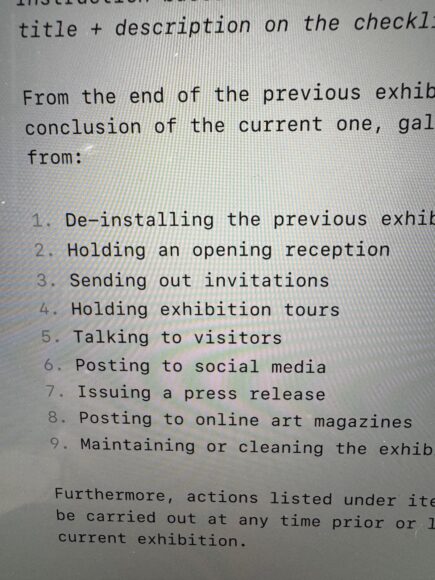
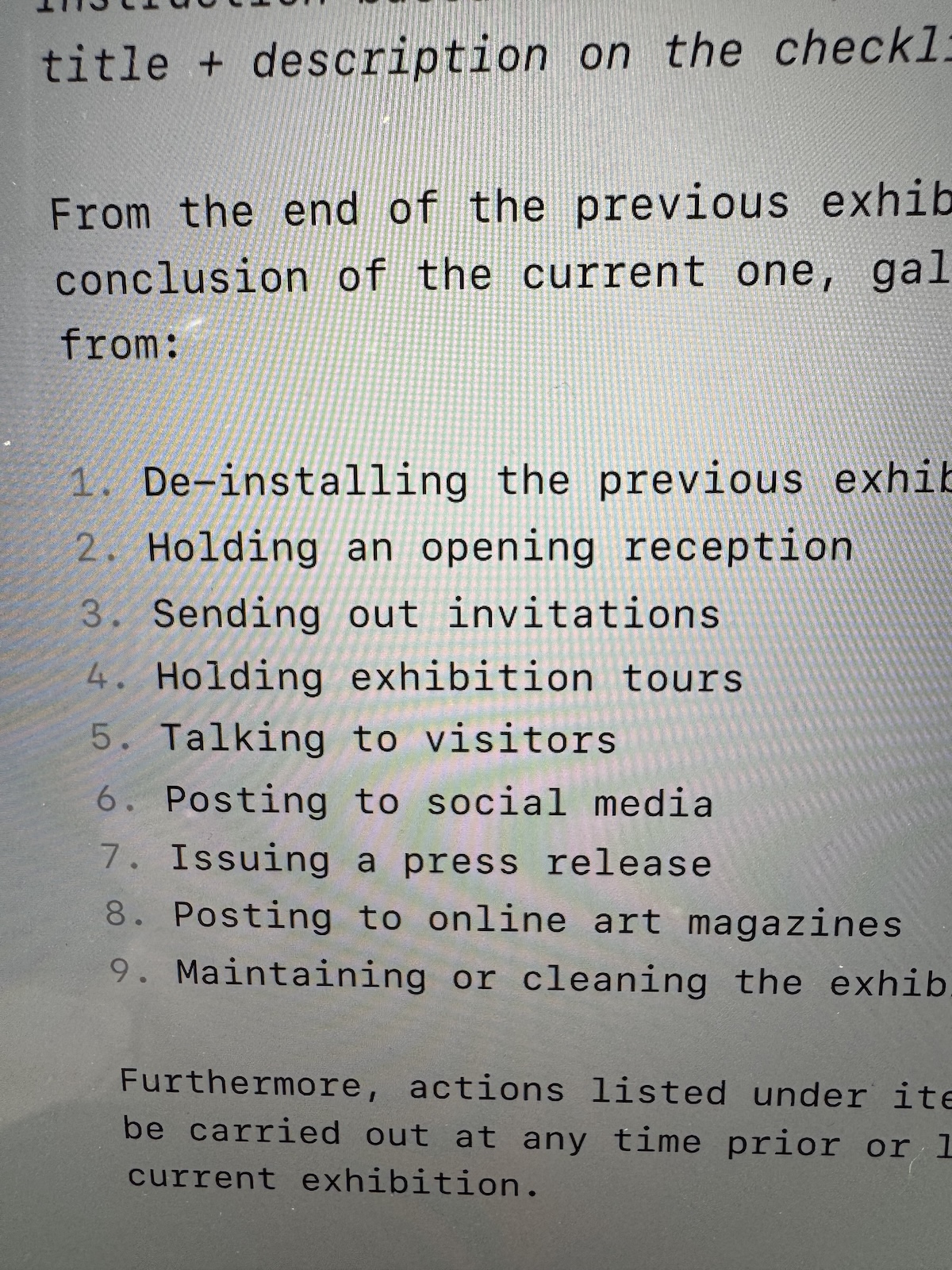
From the end of the previous exhibition and until the conclusion of the current one, gallery workers must refrain from:
- Clearing out the previous exhibition
- Holding an opening reception
- Sending out invitations
- Holding exhibition tours
- Talking to visitors
- Posting to social media
- Issuing a press release
- Posting to online art publications
- Maintaining or cleaning the exhibition space
O.H. D.H. D.K. M.K
Digital print of artist contract on paper, wooden frames remaining from Piotr Łakomy’s 2020 exhibition
Special thanks to Dominika, Daniel, Sebastian, Gerardo, Justyna, Tomasz, Katarzyna, Marcin.
Courtesy the artist Oleksandr Holiuk. The exhibition is co-financed with funds from the Department of Culture of the City of Poznań and the Department of Culture of the Marshal’s Office of the Greater Poland Voivodeship in Poznań.
3D Exhibition View
Full Screen: Press the “f” key on your keyboard or click the double arrow icon in the bottom right corner of the window. Press Esc to exit full-screen mode.
Rotate View: Click and drag with your mouse (or swipe with one finger on the trackpad).
Pan / Move in Space: Right-click and drag (or swipe with two fingers on the trackpad).
Zoom: Use the mouse wheel or the “pinch” gesture on the trackpad to zoom in and out.